In the dynamic landscape of business, understanding and measuring brand equity is not just an option, but a necessity. It's the intangible value that sets you apart in the market, the sum total of how customers perceive your brand. But how do you quantify something as abstract as brand equity? Let's delve into the world of measuring brand equity, exploring key methods, step-by-step processes, and real-life applications.
Before we dive in, let's demystify brand equity. According to marketing guru David Aaker, it's "the added value endowed on a product with a brand name compared to those products without the brand name." In essence, it's the premium price a customer happily pays for a branded product over a generic one.
Understanding Brand Equity
To measure brand equity, you first need to grasp its four key dimensions: brand awareness, brand associations, perceived quality, and brand loyalty.


Brand awareness is the mother of recognition. If consumers can't remember or recognize your brand, they can't interact with it. It's measured through brand recall (can the consumer name your brand when thinking about a product category?) and brand recognition (can the consumer identify your brand when presented with multiple options?).
Measuring Brand Awareness
Surveys are the most common tool for measuring brand awareness. IBM's insistence on the term "Think" in all its advertising resulted in a brand awareness score of 97%. That's the power of awareness.


Next up, consider online surveys to reach a broader and more diverse audience. sights (e.g., Google Trends) can also provide valuable insights into brand recall over time.
Assessing Perceived Quality and Brand Associations
Perceived quality is the brand's reputation for delivering superior performance. Apple's brand, for instance, is synonymous with high quality and innovation. Surveys can uncover perceived quality by asking consumers to rate brands on several attributes (reliability, durability, performance, design, and innovation).
Brand associations are the thoughts, feelings, and attitudes that come to mind when someone hears your brand name. They can be measured through projective techniques, such as word associations (choose the first word that comes to your mind when you think of our brand), or by asking consumers to complete a sentence (what does the brand stand for? What do you think about when you hear this brand name?).


The Four-Step Process: Measuring Brand Equity
Now that we've dissected the components of brand equity, let's discuss how to measure it. The four-step process, outlined by Aaker, involves benchmarking competitors, measuring brand strength, assessing financial equity, and analyzing brand-attribute relationships.
First, benchmarking your competitors gives you a clear perspective. Identify key players, rate them against the same metrics you're using for your brand, and understand the competitive landscape. Most importantly, compare your brand to the highest standard, not the average.
Measuring Brand Strength
Market research comes into play here, with surveys and focus groups helping you understand consumer perception. Measure each of the brand equity dimensions (awareness, associations, quality, loyalty), using scales like the(stringent, reliable assessment tools).


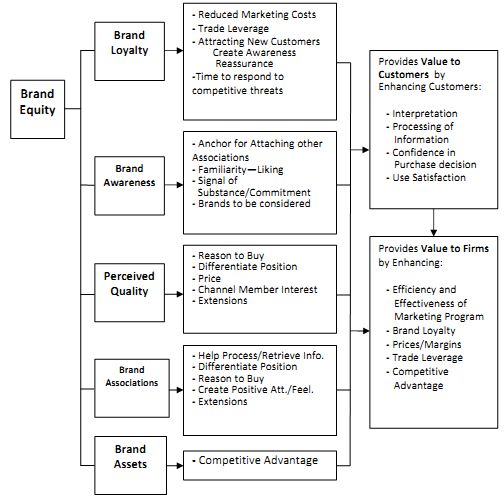
For brand loyalty, consider the Net Promoter Score (NPS), measuring the likelihood of customers recommending your brand to others. A high NPS suggests strong brand loyalty and advocacy.
Assessing Financial Equity
Market research can give you a snapshot, but to understand financial equity, delve into your brand's financials. Consider premium pricing potential, cost savings from brand-specific efficiencies, and market value (via discounted cash flow analysis).
Brand extensions and new product introductions can also add to financial equity. If consumers trust your brand, they'll be more likely to try new products, boosting sales and market share.
Analyzing Brand-Attribute Relationships
The final step connects your brand attributes to financial outputs. Use regression analysis to identify which brand equity dimensions drive financial performance. This can help you prioritize brand-building efforts and maximize impact.
Take Pepsi, for example. Despite consistently losing market share to Coca-Cola, its brand equity remains strong. Its brand associations (fun, excitement, youth, refreshment) and perceived quality drive its financial metrics, making it a successful brand despite its market position.
In today's interconnected world, accurate measurement of brand equity is more important than ever. Brands that understand and cultivate their equity empower themselves to weather storms, innovate into new spaces, and ultimately outperform their competitors. So, the next time you're thinking about your brand, remember the words of David Ogilvy, "Never stop testing, and your advertising will never stop improving." The same principle applies to measuring your brand equity.